


Links





High yield Scuttlebutt
News of the bloodbath in the shipping markets continues to spill into the mainstream financial trade press. Most recently, Investment Dealer’s Digest ran a story entitled “Shipping Finance Founders as Banks Begin Arresting Ships.” On the high yield front, only $136 million flowed into the market and eight deals priced with two postponements the week we went to press. The slowdown is attributed to weakness in treasuries and shaky equity markets.
Since our last issue, Alpha filed its 10K with the SEC, which revealed that Mr. George Economou has agreed to pay himself almost $3 million in fees if he succeeds in restructuring Alpha Shipping. Generous. Alpha became the first shipping issuer to default when it failed to make its February 15th coupon payment. Standard & Poor’s subsequently downgraded Alpha from CC to D. There is no confidence that the company will be in position to make its coupon payment under the 30-day grace period.
Continue Reading
Cooperating with Eletson
by Matt McCleery
The relationship between high yield investors and issuers is never a simple one. Even for companies like Eletson Corporation of Greece whose bonds trade in the rarefied neighborhood of par, there is an inherent struggle which arises because of the fact that what’s good for the equity is not always good for the debt. Put another way, increasing shareholder value is generally achieved by spending that which makes debt more valuable – cash. That is the challenge that Eletson is presently facing with respect to its $140 million in 9.25% first preferred ship mortgages notes due in 2003.
Compromising Positions
In Eletson’s case, the company has $60 million of free cash on its balance sheet, but due to the weakness in the charter market, the debt incurrence covenants in the bond indenture prevent it from borrowing money to make leveraged acquisitions. While it is true that Eletson could use the $60 million to make unleveraged acquisitions, the company’s penchant for newbuildings will prevent it from having enough buying power to fully exploit the opportunities in the market.
Continue Reading
When Will the Dead Cat Bounce?
Well, we must sadly inform the readership that, for the first time since Marine Money started to comment on the international shipping equity market, all arrows are pointing to a certain hot place down below. The fact that the Oslo market, accompanied by our shipping indices, is down is of no surprise, but that the cruise index is heading in the same direction has left a black mark on our calendar. Looking back at the numbers we used to build the index, we must travel back to July of last year to find a comparable set of miserable numbers, and we assume that no one has forgotten what preceded July.
The worst performing index this month was the offshore index – down 12.4% since February 3rd. North Sea oil, which traded over $11 per barrel in January, dipped very close to the $10 mark, which spooked many investors. The editorial staff of Marine Money will be very worried if it should fall below the “psychological price floor” of $10. We do not think anyone has the stomach to own oil service stocks if we were to ever see single digit oil prices.
Continue Reading
Banking on Relationships
It seems that anyone who doesn’t have exposure to the spot market has a great advantage in the present lending market, and ferries are leading the charge. Cenargo is performing better than most high yield issues, and bank financing in the ferry sector has emerged. Strinziz has recently borrowed $175 million in a syndicated facility arranged by ABN and Landesbank Schleswig-Holstein. Participants in that deal included Alpha Credit Bank, Bank of Piraeus, Alpha Bank London, Commercial Bank of Greece, Credit Lyonnais, National Bank of Greece and Viking Ship Finance. The funds will be used to pay for the acquisition of new and secondhand ferries. BC Ferries is in the market looking to finance three high speed catamarans worth about $250 million through a sale lease back structured by CIBC and Enbom Capital.
Continue Reading
Recent Bilaterals – March 1999
Recent Bilaterals – March 1999 Continue Reading
Syndicated Loans – February 1999
Syndicated Loans – February 1999 Continue Reading
Equity – February 1999
Equity – February 1999 Continue Reading
Is Teekay Tempting?
Back in January 1997, Teekay made a first class presentation to the investment community. It was a case of the right company (world’s largest and most modern Aframax fleet) being concentrated in the right place (Indo-Pacific Basin) at the right time (virile Asian tigers siring healthy, fast-growing cubs). Later that year ,the stock reached its high at USD 38 before being caught in the Asian wind sheer that brought it down to its present level (Figure 1). It is such conditions that put the test to lofty sounding company assertions like “privileged access to certain localities,” and thus far, Teekay has lived up to its reputation as a world class shipping company in every sense. However, this has not stopped investors from abandoning the stock. The obvious question is whether or not Teekay is presently a buy.
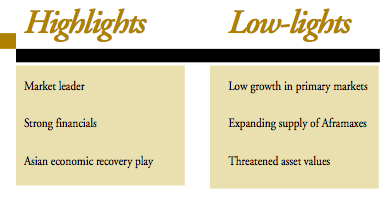
We think the answer to this question lies in how the economic problems in Asia play out. Is this just another challenging time in the recurring cycle from which strong companies like Teekay emerge even stronger? Or have Asia’s woes, directly or indirectly, contributed to change in the Aframax market structure that reaches beyond one place and one time and extends far into the future?
Continue Reading
RIVAL P&I PARTIES
by Graham Barnes, Chairman, BankAssure Insurance Services Limited, General / Rival P&I Parties
A continuation of the article published January 16th 1997 titled “Concerns of the Unwelcome Guests”
How will the Fixed Premium P&I facilities fare against the International Group Clubs at this interesting and crucial renewal?
If the Fixed Premium facilities fail to make an impact on the P&I scene in this state of the market, the answer will be “none”. However, if they do carve out a market share sufficient to make some impact on the IGA clubs’ monopoly and continue to establish credibility, their share of the protection and indemnity market should progressively grow with each renewal. An Overspill claim, or even the threat of an Overspill claim, will accelerate the switch away from the IGA clubs.
Continue Reading
Movers & Shakers
FREDERICK CHAVALIT TSAO, Chairman of IMC, Singapore, succeeded Sverre Tidemand as Chairman of the International Association of Dry Cargo Shipowners. Looking ahead at a time of desperately poor freight rates for dry bulk shipowners, Mr. Tsao said, “Now, more then ever, the dry bulk sector needs a strong voice.” (Not to mention better rates.)
Continue Reading
The Official Guide To Marine Finance Providers

Shipping Index
